Box rule & measurement
What is the IMCA Moth box rule?
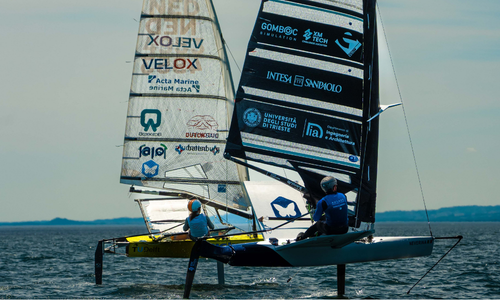
The box rule sets the outer limits for the boat (length, beam, sail area, a few structural constraints) but leaves almost everything else open. That’s what makes it sensitive: inside those limits, a small change in material or geometry can decide the result.
When and how are boats measured?
Boats are measured by the Jury on-site before racing, checked against the box rule limits by the jury’s measurement team.
What happens if my boat fails measurement?
A boat that fails the box-rule measurement wont be allowed to take part in the Dynamic stages S2 and S3.
Can we modify the boat after measurement?
Yes, minor modifications are allowed as long as they remain inside the box-rule tolerances.
The three stages & scoring
How are the stages weighted?
Overall, the Static (S1) and Dynamic (S2+S3) stages are split equally 50-50 overall.
Can we enter only one stage?
Yes. A First Year Rookies (FYR) Team can register for S1 only, to build design experience without committing to build or race on year one. The following year the team must compete on Stages S2 and S3.
What happens if we pass S1 but can’t build in time for S2?
For a FYR Team, this is not a problem. For a team who has already competed in any previous stage would result in an impossibility to participate.
Is scoring cumulative across stages, or does each stage stand alone?
Both. Each stage is scored as a stand alone challenge on the three stages. The team who cumulates the most points over the three stages of the same year is the Overall winner of the SuMoth Challenge.
Sustainability & lifecycle
How is sustainability actually scored?
Sustainability is measured with MarineShift360, a life-cycle assessment tool built for the marine industry. Teams run it throughout design and manufacturing, not just at the end, so the score reflects real decisions, not a report written after the fact.
What is the SuMoth Dollar (SM$) system?
SM$ is a virtual budget that prices materials and processes by environmental impact, not just cash cost. A material that’s cheap but hard to recycle, like EPS foam, costs more SM$ than a pricier, lower-impact alternative. It stops teams from being pushed toward unsustainable choices just to stay under a financial cap.
Do upcycled or reused components score differently than new ones?
Yes. Teams building on a prior SuMoth boat are treated differently from teams upcycling an external hull, and upcycled-boat teams have to declare a specific planned innovation as a condition of entry.
What LCA tool do we need to use, and is it provided?
MarineShift360 the leading LCA tool for the marine industry, and access is provided as part of registration.
Eligibility & registration
Who can enter?
Any university-affiliated student team, anywhere in the world.
Do all team members need to be currently enrolled students?
Exceptions apply for recently graduated alumni. Otherwise all member must be formally enrolled students.
Can multiple universities form a joint team?
Yes, a joint project is accepted. While the team leaders could be of different Universities, the responsibility remains on the Team Manager (non-student member).
Is there a fee to register?
Registration is free of charge as per 2027 Rulebook. Failure to communicate, missed deadlines with no response, or disengaging from the process without notice will result in a long-term ban for the represented university from future editions. Free entry depends on teams treating the commitment seriously.
What happens after we submit our registration intention?
Submitting your intention doesn’t commit you to anything yet. It puts your team in line for the review process ahead of formal registration and Team Declaration.
Can a team re-enter after competing in a previous edition?
Yes, returning teams are common and marked as Legacy Teams at registration. But past participation doesn’t guarantee a spot. Selection comes down to innovation and sustainability, the same as for any new team, and space is limited: 20 spots for the Dynamic stages, 25 for the Static stage.